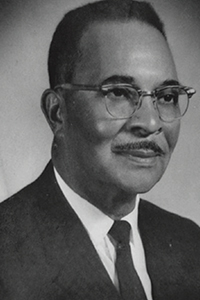
Winston Douglas
In the early 1930s, Norfolk, Virginia stood at a crossroads. The Great Depression was tightening its grip, job opportunities were scarce, and avenues for African Americans to pursue higher education in the region were almost nonexistent. Yet in this atmosphere of uncertainty, a group of visionary Black leaders imagined something radically different: a homegrown institution of higher learning that would nurture talent, expand opportunity, and transform the future of Hampton Roads.
At the center of this vision stood Winston Douglas, the respected principal of Booker T. Washington High School. Known for his dedication to education and community empowerment, Douglas emerged as a galvanizing force at a moment when many had stopped daring to dream. As economic hardship deepened and racial barriers persisted, he looked beyond the constraints of the era and saw the necessity of a college built by—and built for—the African American community of Norfolk.
Douglas accepted the responsibility of chairing the committee tasked with establishing a junior college in the city—an effort that would ultimately grow into the Norfolk Unit of Virginia Union University. He understood that no individual effort would be enough; what the project demanded was unity, strategy, and the collective strength of Black leadership across Norfolk. To that end, he convened educators, clergy members, medical professionals, businesspeople, and philanthropists—men and women who shared the belief that education was key to long‑term empowerment.
Among those who joined him were well‑known community figures such as educator Ruth Hucles, Reverend Richard Bowling of First Baptist Church, Dr. G. Hamilton Francis, Dr. D. W. Byrd, Reverend Bravid Harris, businessman William T. Mason, and publisher P. B. Young of the Journal and Guide. In total, forty‑one community leaders came together under Douglas’s leadership, forming scholarship committees, strategizing recruitment plans, and raising funds to bring their shared dream into reality.
As the committee worked, a new possibility began to take shape. What had started as an idea evolved into a coordinated community movement. Despite the harsh economic climate of the Depression, the group pressed forward—knocking on doors, advocating for students, and rallying the resources needed to open the school.
Their persistence bore fruit on September 18, 1935, when the Norfolk Unit of Virginia Union University opened its doors on the second floor of the Hunton YMCA on Brambleton Avenue. With 85 students, a small faculty, and modest facilities, the school represented more than a new academic venture—it was a statement of belief in the boundless potential of Norfolk’s Black youth.
What Douglas and his committee set in motion reshaped the educational landscape of the region. The Norfolk Unit eventually grew into Norfolk State University, one of the nation’s most significant Historically Black Colleges and Universities (HBCUs). Every step of its development—from its first classes to its expansion, independence, and eventual recognition as a university—can be traced back to the foundation laid by Winston Douglas and the team he led.
His leadership provided more than administrative oversight; it offered hope. At a time when structural barriers sought to limit Black advancement, Douglas and his collaborators pushed back through institution‑building—an act of courage, vision, and community determination.