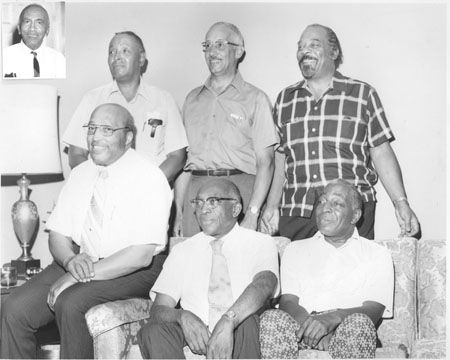
The 7 Pillars of Granite
The 7 Pillars of Granite were strong, solid foundations that showcased the university's values. George William Clement Brown, Sanford Maurice, Clyde McDaniel, James Douglas Gill, Dr. Herbert Archie Marshall, and Hollis Sidney Tildon were chosen because they exemplified the college's cornerstones. They validated Brook's wisdom by selflessly taking on numerous leadership roles and devoting an average of thirty-eight years and two months to the institution. George Brown succeeded Lyman in service to the school as the director of the evening college and adult services. In addition, Dr. Marshall was hired by Brooks to teach history. He solely taught African American history for decades until its popularity grew in the 1960s. James Douglass Gill was hired to teach English history and to coach the football team. He helped organize the Eastern Intercollegiate Athletic Association (CIAA). Clyde McDaniel became the first full-time mathematics teacher when he was hired. He also served as the head of the mathematics department for over three decades. Hollis Sydney Tildon was the first person to be employed by Brooks when he signed his contract in 1938. He served as the college's linguist for over three decades. He served the university and retired in 1975. Sanford Maurice came to the Norfolk unit in 1939 after attaining his degree from Denver University. He established the college's university of business department and taught all of its classes. He also served as the university's basketball coach. In addition, he is most notable for enlisting in the Air Force and serving as a flight leader with the famed Tuskegee Airmen, 332nd Fighter Group, in World War II.