A Journey Fueled by Love and Legacy
Roderick Bell ’96 was on a mission. Through fatigue, aching muscles, and blurry eyesight, he rode. Day after day, for 24 days and mile after mile for 9,529 miles, he rode. The mission: to ride his Norfolk State-themed motorcycle to each of the country’s approximately 106 Historically Black Colleges and Universities (HBCUs) and challenge 1,006 alumni at each school to give $106 to their alma mater—to invest in the future of the very places that gave them everything.
On Aug. 31, 2025, when Bell climbed onto his green-and-gold motorcycle and began his journey, he carried the hopes of generations. Starting in North Carolina, he rode to South Carolina, Georgia, Florida, Alabama, Louisiana, Mississippi, Texas, Arkansas, Missouri, Tennessee, Kentucky, Ohio, Michigan, Washington, D.C., Maryland, Pennsylvania, and Virginia. His quest— Ride4MyHBCUs—went beyond just raising funds for each of the schools. It was also about changing minds.
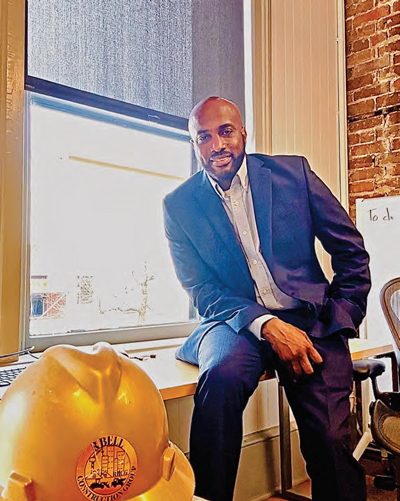 “This is about action,” Bell said at the time. “It’s about inspiring alumni and supporters to give back and invest in the future of HBCUs.” He added, “We show up for homecomings, classics, step shows, and the battle of the bands. We spend money on parties, travel, and tailgates. Now, I’m asking you to show up for your school in a different way.”
“Let’s give back to the institutions that gave us everything.”The way Bell sees it, there is a difference between an HBCU graduate and an HBCU alumnus. “An HBCU graduate is someone who earns a degree and returns only for homecomings and festivals without reinvesting in the institution,” he said. “An HBCU alumnus, however, actively reinvests in their university—financially, through alumni associations, by engaging in the community, and by promoting their HBCU wherever they go.”
Why it Matters
According to a UNCF report, “ When we compare HBCUs to the national average and highly selective schools, HBCUs are far more accessible to students and far more successful at moving students from the bottom 40% of the income distribution to the top 60% of the income distribution, signaling social mobility.”
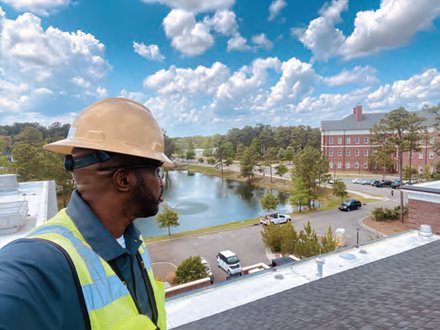 “But HBCUs face significant and persistent funding challenges, impacting the ability to fulfill their missions and serve their students effectively,” Bell said. Bell’s deep affection and loyalty to HBCUs stem from his own story. While he came to Norfolk State on a track scholarship, what he found went deeperthan having his college tuition paid. He found a place where he could truly thrive. “Norfolk State took a chance on a kid from the Eastern Shore of Virginia and gave me the opportunity to still run track and do it at the University.”
Bell sealed his career path when, as a teenager, he built a clubhouse in his yard from leftover tin that had been used to wrap around the bottom of the mobile home where he lived, impressing his mother. When he arrived at Norfolk State, Bell chose architectural drafting as his major, but his advisor steered him toward majoring in construction engineering. “When I was about to graduate, there were two alumni…Derrick L. Gay and Stephon Artis, if it weren’t for these two guys, I wouldn’t be where I am today.” Bell goes on to describe how Artis and Gay, who worked for Centex at the time, were assigned to visit Old Dominion University to recruit. However, since they graduated from Norfolk State, they went there instead and recruited Bell.
Gay, now CEO of Dominion Builders & Contracting LLC, said Bell impressed them. “He was responsive, his interview was professional, and he was personable and charismatic. We knew with his energy that he could come in and help right away, as he did.”
From there, Bell has worked on landmark projects, including Norfolk International Airport, Dulles International Airport, the U.S. Capitol Visitors Center, and the national World War II Memorial. He later moved to North Carolina and, after working for a few other companies, opened his own.
The Bike that Tells a Story
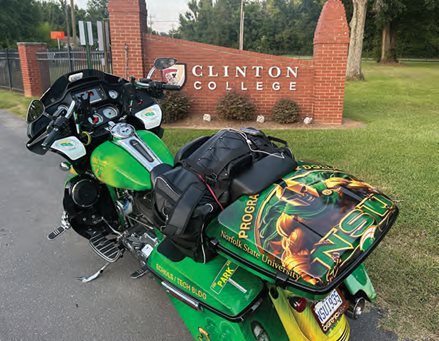 The head-turning motorcycle he rode on his odyssey is more than a machine; it’s a homage to Norfolk State. A green and gold Harley Davidson named Sparta, the bike is outfitted with photos of NSU’s second President, Harrison B. Wilson Jr.; the “White House” that once stood on campus; Quiara Jackson, the first Spartan Legion female drum major; Football head coach Michael Vick; Scott Hall; the Sweat Box, among other icons that are of meaning to him. His research indicates that his bike is the first HBCU motorcycle in the U.S. Bell’s riding playlist across those nearly 10,000 miles spanned from old-school hip hop and R&B, to DMX, new school hip hop and of course the Clipse, and in some of his appearances on campus with his bike, Bell has blared the Spartan Legion’s rendition of “The Neck” from his radio.
Reflecting on his trip, Bell now understands much more about both the financial situations of our nation’s HBCUs and the challenges that many of their alumni face. He learned that a small percentage of graduates give back to their schools. Reasons vary.
“Over time, I’ve learned that many graduates who earn degrees in fields that do not pay as much often struggle to give back financially. In many cases, they are working second jobs just to cover their basic expenses. Similarly, those who graduate from medical school are frequently unable to give back immediately due to the overwhelming debt they carry upon graduation. Some accept lower-paying positions to gain experience, others attempt to start their own practices, and many are simultaneously building families. For these graduates, it can take 10 to 15 years before they are financially positioned to give back to their university.”
He added that while alumni may not give back, those who do recognize how their contributions help students facing the same challenges that they once did. Bell also believes that faculty interaction with students also plays a part in whether graduates contribute to the university.
The Legacy
Roderick Bell’s 24-day odyssey was more than a ride—it was a call to action. His journey was about the students who dream big, the alumni who carry the torch, and the institutions that continue to change lives against all odds. His call to action is clear and urgent: Show up for your school in a different way—because the future of HBCUs depends on it.